A vehicle that performs at it's peak will realize the best fuel economy. If something interferes with peak performance it will decrease gas economy and will cause you to use more gas and spend more money. For that reason proper management of the oil in your engine is a critical component of good fuel economy.
You need to make scheduled oil changes a priority in maintaining your car. Following the auto producers oil change recommendations is a major component of keeping your car running at its peak and keeping your gasoline economy at its best.
The purpose of the oil in your vehicle is to prevent metal- to-metal contact of engine parts by lubricating its moving parts, thereby minimizing friction and carrying away excess heat. All of those attributes create better gasoline efficiency.
Motor oil also removes dirt, metal shavings and other impurities from the engine and captures them in the oil filter. You can pay a severe penalty for neglecting engine oil, possibly even needing to replace the engine itself. Keeping track of your last oil change will save you money at the gas pump and decrease your fuel consumption.
The interval between oil changes is very important. It is important to following the car makers maintenance schedule. If the manual says to change the oil every three months do it. If the manual says to change the oil every three thousand miles do it. When oil is left in an engine too long, it becomes saturated with the very dirt and impurities it is supposed to remove. Once the oil is saturated it will be less efficient in doing its job. Your car's performance will decline and your fuel economy will get worse.
Another facet of proper oil care is to make sure that you are using the right grade of oil. You should use the grade of oil recommended in your owner's manual. The fuel efficiency of the engine can improve as much as 2 percent versus using the wrong grade oil especially when starting in cold weather.
Using the wrong grade of oil may cause your car to run poorly as the weather changes. The wrong grade will get thick and heavy in cold weather. Oil that is too thick and heavy requires the engine to work harder because the thick and heavy oil's resistance is greater. The harder the engine works the more gasoline it will use. The wrong grade of oil can cost you 1 to 2 percent of your gas economy.
If you use, for example, 10W-40 motor oil in an engine designed to use 5W-40 it can lower your gas mileage as much as the two percent mentioned earlier. In addition if something goes wrong with your car, and the manufacturer can show you used the wrong oil, it could void your warranty.
Many drivers make the mistake of procrastinating in getting the oil changed. The more a driver puts off changing the oil the worse the fuel economy will be. Using the proper grade and changing the oil on time will help you get better gas economy.
Showing posts with label Automobile Information. Show all posts
Showing posts with label Automobile Information. Show all posts
AutoMobile Safety
Road traffic injuries represent about 25% of worldwide injury-related deaths (the leading cause) with an estimated 1.2 million deaths (2004) each year.[22]
Automobile accidents are almost as old as automobiles themselves. Early examples include Mary Ward, who became one of the first documented automobile fatalities in 1869 in Parsonstown, Ireland,[23] and Henry Bliss, one of the United State's first pedestrian automobile casualties in 1899 in New York.[24]
Cars have many basic safety problems - for example, they have human drivers who can make mistakes, wheels that can lose traction when braking, turning or acceleration forces are too high, and mechanical systems subject to failure. Collisions can have very serious or fatal consequences. Some vehicles have a high center of gravity and therefore an increased tendency to roll over.
Early safety research focused on increasing the reliability of brakes and reducing the flammability of fuel systems. For example, modern engine compartments are open at the bottom so that fuel vapors, which are heavier than air, vent to the open air. Brakes are hydraulic and dual circuit so that a total braking failure is very rare. Systematic research on crash safety started[citation needed] in 1958 at Ford Motor Company. Since then, most research has focused on absorbing external crash energy with crushable panels and reducing the motion of human bodies in the passenger compartment. This is reflected in most cars produced today.
Significant reductions in death and injury have come from the addition of Safety belts and laws in many countries to require vehicle occupants to wear them. Airbags and specialised child restraint systems have improved on that. Structural changes such as side-impact protection bars in the doors and side panels of the car mitigate the effect of impacts to the side of the vehicle. Many cars now include radar or sonar detectors mounted to the rear of the car to warn the driver if he or she is about to reverse into an obstacle or a pedestrian. Some vehicle manufacturers are producing cars with devices that also measure the proximity to obstacles and other vehicles in front of the car and are using these to apply the brakes when a collision is inevitable. There have also been limited efforts to use heads up displays and thermal imaging technologies similar to those used in military aircraft to provide the driver with a better view of the road at night.
There are standard tests for safety in new automobiles, like the EuroNCAP and the US NCAP tests.[25] There are also tests run by organizations such as IIHS and backed by the insurance industry.[26]
Despite technological advances, there is still significant loss of life from car accidents: About 40,000 people die every year in the United States, with similar figures in European nations. This figure increases annually in step with rising population and increasing travel if no measures are taken, but the rate per capita and per mile traveled decreases steadily. The death toll is expected to nearly double worldwide by 2020. A much higher number of accidents result in injury or permanent disability. The highest accident figures are reported in China and India. The European Union has a rigid program to cut the death toll in half by 2010, and member states have started implementing measures.
Automated control has been seriously proposed and successfully prototyped. Shoulder-belted passengers could tolerate a 32 g emergency stop (reducing the safe inter-vehicle gap 64-fold) if high-speed roads incorporated a steel rail for emergency braking. Both safety modifications of the roadway are thought to be too expensive by most funding authorities, although these modifications could dramatically increase the number of vehicles able to safely use a high-speed highway. This makes clear the often-ignored fact road design and traffic control also play a part in car wrecks; unclear traffic signs, inadequate signal light placing, and poor planning (curved bridge approaches which become icy in winter, for example), also contribute.
Automobile accidents are almost as old as automobiles themselves. Early examples include Mary Ward, who became one of the first documented automobile fatalities in 1869 in Parsonstown, Ireland,[23] and Henry Bliss, one of the United State's first pedestrian automobile casualties in 1899 in New York.[24]
Cars have many basic safety problems - for example, they have human drivers who can make mistakes, wheels that can lose traction when braking, turning or acceleration forces are too high, and mechanical systems subject to failure. Collisions can have very serious or fatal consequences. Some vehicles have a high center of gravity and therefore an increased tendency to roll over.
Early safety research focused on increasing the reliability of brakes and reducing the flammability of fuel systems. For example, modern engine compartments are open at the bottom so that fuel vapors, which are heavier than air, vent to the open air. Brakes are hydraulic and dual circuit so that a total braking failure is very rare. Systematic research on crash safety started[citation needed] in 1958 at Ford Motor Company. Since then, most research has focused on absorbing external crash energy with crushable panels and reducing the motion of human bodies in the passenger compartment. This is reflected in most cars produced today.
Significant reductions in death and injury have come from the addition of Safety belts and laws in many countries to require vehicle occupants to wear them. Airbags and specialised child restraint systems have improved on that. Structural changes such as side-impact protection bars in the doors and side panels of the car mitigate the effect of impacts to the side of the vehicle. Many cars now include radar or sonar detectors mounted to the rear of the car to warn the driver if he or she is about to reverse into an obstacle or a pedestrian. Some vehicle manufacturers are producing cars with devices that also measure the proximity to obstacles and other vehicles in front of the car and are using these to apply the brakes when a collision is inevitable. There have also been limited efforts to use heads up displays and thermal imaging technologies similar to those used in military aircraft to provide the driver with a better view of the road at night.
There are standard tests for safety in new automobiles, like the EuroNCAP and the US NCAP tests.[25] There are also tests run by organizations such as IIHS and backed by the insurance industry.[26]
Despite technological advances, there is still significant loss of life from car accidents: About 40,000 people die every year in the United States, with similar figures in European nations. This figure increases annually in step with rising population and increasing travel if no measures are taken, but the rate per capita and per mile traveled decreases steadily. The death toll is expected to nearly double worldwide by 2020. A much higher number of accidents result in injury or permanent disability. The highest accident figures are reported in China and India. The European Union has a rigid program to cut the death toll in half by 2010, and member states have started implementing measures.
Automated control has been seriously proposed and successfully prototyped. Shoulder-belted passengers could tolerate a 32 g emergency stop (reducing the safe inter-vehicle gap 64-fold) if high-speed roads incorporated a steel rail for emergency braking. Both safety modifications of the roadway are thought to be too expensive by most funding authorities, although these modifications could dramatically increase the number of vehicles able to safely use a high-speed highway. This makes clear the often-ignored fact road design and traffic control also play a part in car wrecks; unclear traffic signs, inadequate signal light placing, and poor planning (curved bridge approaches which become icy in winter, for example), also contribute.
Automobile History
Car" redirects here. For other uses, see Car (disambiguation).
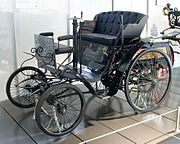
Karl Benz's "Velo" model (1894) - entered into an early automobile race
Passenger cars in 2000An automobile (via French from Greek auto, self and Latin mobilis moving, a vehicle that moves itself rather than being moved by another vehicle or animal) or motor car (usually shortened to just car) is a wheeled passenger vehicle that carries its own motor. Most definitions of the term specify that automobiles are designed to run primarily on roads, to have seating for one to eight people, to typically have four wheels, and to be constructed principally for the transport of people rather than goods.[1] However, the term is far from precise because there are many types of vehicles that do similar tasks.
There were 590 million passenger cars worldwide (roughly one car for every eleven people) as of 2002.[2]
 Main article: History of the automobile
Although Nicolas-Joseph Cugnot is often credited with building the first self-propelled mechanical vehicle or automobile in about 1769, this claim is disputed by some, who doubt Cugnot's three-wheeler ever ran, while others claim Ferdinand Verbiest, a member of a Jesuit mission in China, built the first steam powered car around 1672.[3][4] In either case François Isaac de Rivaz, a Swiss inventor, designed the first internal combustion engine which was fuelled by a mixture of hydrogen and oxygen and used it to develop the world's first vehicle to run on such an engine. The design was not very successful, as was the case with Samuel Brown, Samuel Morey, and Etienne Lenoir who each produced vehicles powered by clumsy internal combustion engines.[5]
In November 1881 French inventor Gustave Trouvé demonstrated a working three-wheeled automobile. This was at the International Exhibition of Electricity in Paris.[6]
An automobile powered by an Otto gasoline engine was built in Mannheim, Germany by Karl Benz in 1885 and granted a patent in January of the following year under the auspices of his major company, Benz & Cie. which was founded in 1883.
Although several other German engineers (including Gottlieb Daimler, Wilhelm Maybach, and Siegfried Marcus) were working on the problem at about the same time, Karl Benz is generally acknowledged as the inventor of the modern automobile.[5] In 1879 Benz was granted a patent for his first engine, designed in 1878. Many of his other inventions made the use of the internal combustion engine feasible for powering a vehicle and in 1896, Benz designed and patented the first internal combustion flat engine.
Approximately 25 Benz vehicles were built and sold before 1893, when his first four-wheeler was introduced. They were powered with four-stroke engines of his own design. Emile Roger of France, already producing Benz engines under license, now added the Benz automobile to his line of products. Because France was more open to the early automobiles, more were built and sold in France through Roger than Benz sold in Germany.
Daimler and Maybach founded Daimler Motoren Gesellschaft (Daimler Motor Company, DMG) in Cannstatt in 1890 and under the brand name, Daimler, sold their first automobile in 1892. By 1895 about 30 vehicles had been built by Daimler and Maybach, either at the Daimler works or in the Hotel Hermann, where they set up shop after falling out with their backers. Benz and Daimler seem to have been unaware of each other's early work and worked independently.
Daimler died in 1900 and later that year, Maybach designed a model named Daimler-Mercedes, special-ordered by Emil Jellinek. Two years later, a new model DMG automobile was produced and named Mercedes after the engine. Maybach quit DMG shortly thereafter and opened a business of his own. Rights to the Daimler brand name were sold to other manufacturers.
Karl Benz proposed co-operation between DMG and Benz & Cie. when economic conditions began to deteriorate in Germany following the First World War, but the directors of DMG refused to consider it initially. Negotiations between the two companies resumed several years later and in 1924 they signed an Agreement of Mutual Interest valid until the year 2000. Both enterprises standardized design, production, purchasing, sales, and advertising—marketing their automobile models jointly—although keeping their respective brands. On June 28, 1926, Benz & Cie. and DMG finally merged as the Daimler-Benz company, baptizing all of its automobiles Mercedes Benz honoring the most important model of the DMG automobiles, the Maybach design later referred to as the 1902 Mercedes-35hp, along with the Benz name. Karl Benz remained a member of the board of directors of Daimler-Benz until his death in 1929.
In 1890, Emile Levassor and Armand Peugeot of France began producing vehicles with Daimler engines, and so laid the foundation of the motor industry in France. The first American car with a gasoline internal combustion engine supposedly was designed in 1877 by George Selden of Rochester, New York, who applied for a patent on an automobile in 1879. In Britain there had been several attempts to build steam cars with varying degrees of success with Thomas Rickett even attempting a production run in 1860.[7] Santler from Malvern is recognized by the Veteran Car Club of Great Britain as having made the first petrol-powered car in the country in 1894[8] followed by Frederick William Lanchester in 1895 but these were both one-offs.[8] The first production vehicles came from the Daimler Motor Company, founded by Harry J. Lawson in 1896, and making their first cars in 1897.[8]
In 1892, German engineer Rudolf Diesel got a patent for a "New Rational Combustion Engine". In 1897 he built the first Diesel Engine.[5] In 1895, Selden was granted a United States patent(U.S. Patent 549,160 ) for a two-stroke automobile engine, which hindered more than encouraged development of autos in the United States. Steam, electric, and gasoline powered autos competed for decades, with gasoline internal combustion engines achieving dominance in the 1910s.
Although various pistonless rotary engine designs have attempted to compete with the conventional piston and crankshaft design, only Mazda's version of the Wankel engine has had more than very limited success
Karl Benz's "Velo" model (1894) - entered into an early automobile race
Passenger cars in 2000An automobile (via French from Greek auto, self and Latin mobilis moving, a vehicle that moves itself rather than being moved by another vehicle or animal) or motor car (usually shortened to just car) is a wheeled passenger vehicle that carries its own motor. Most definitions of the term specify that automobiles are designed to run primarily on roads, to have seating for one to eight people, to typically have four wheels, and to be constructed principally for the transport of people rather than goods.[1] However, the term is far from precise because there are many types of vehicles that do similar tasks.
There were 590 million passenger cars worldwide (roughly one car for every eleven people) as of 2002.[2]
 Main article: History of the automobile
Although Nicolas-Joseph Cugnot is often credited with building the first self-propelled mechanical vehicle or automobile in about 1769, this claim is disputed by some, who doubt Cugnot's three-wheeler ever ran, while others claim Ferdinand Verbiest, a member of a Jesuit mission in China, built the first steam powered car around 1672.[3][4] In either case François Isaac de Rivaz, a Swiss inventor, designed the first internal combustion engine which was fuelled by a mixture of hydrogen and oxygen and used it to develop the world's first vehicle to run on such an engine. The design was not very successful, as was the case with Samuel Brown, Samuel Morey, and Etienne Lenoir who each produced vehicles powered by clumsy internal combustion engines.[5]
In November 1881 French inventor Gustave Trouvé demonstrated a working three-wheeled automobile. This was at the International Exhibition of Electricity in Paris.[6]
An automobile powered by an Otto gasoline engine was built in Mannheim, Germany by Karl Benz in 1885 and granted a patent in January of the following year under the auspices of his major company, Benz & Cie. which was founded in 1883.
Although several other German engineers (including Gottlieb Daimler, Wilhelm Maybach, and Siegfried Marcus) were working on the problem at about the same time, Karl Benz is generally acknowledged as the inventor of the modern automobile.[5] In 1879 Benz was granted a patent for his first engine, designed in 1878. Many of his other inventions made the use of the internal combustion engine feasible for powering a vehicle and in 1896, Benz designed and patented the first internal combustion flat engine.
Approximately 25 Benz vehicles were built and sold before 1893, when his first four-wheeler was introduced. They were powered with four-stroke engines of his own design. Emile Roger of France, already producing Benz engines under license, now added the Benz automobile to his line of products. Because France was more open to the early automobiles, more were built and sold in France through Roger than Benz sold in Germany.
Daimler and Maybach founded Daimler Motoren Gesellschaft (Daimler Motor Company, DMG) in Cannstatt in 1890 and under the brand name, Daimler, sold their first automobile in 1892. By 1895 about 30 vehicles had been built by Daimler and Maybach, either at the Daimler works or in the Hotel Hermann, where they set up shop after falling out with their backers. Benz and Daimler seem to have been unaware of each other's early work and worked independently.
Daimler died in 1900 and later that year, Maybach designed a model named Daimler-Mercedes, special-ordered by Emil Jellinek. Two years later, a new model DMG automobile was produced and named Mercedes after the engine. Maybach quit DMG shortly thereafter and opened a business of his own. Rights to the Daimler brand name were sold to other manufacturers.
Karl Benz proposed co-operation between DMG and Benz & Cie. when economic conditions began to deteriorate in Germany following the First World War, but the directors of DMG refused to consider it initially. Negotiations between the two companies resumed several years later and in 1924 they signed an Agreement of Mutual Interest valid until the year 2000. Both enterprises standardized design, production, purchasing, sales, and advertising—marketing their automobile models jointly—although keeping their respective brands. On June 28, 1926, Benz & Cie. and DMG finally merged as the Daimler-Benz company, baptizing all of its automobiles Mercedes Benz honoring the most important model of the DMG automobiles, the Maybach design later referred to as the 1902 Mercedes-35hp, along with the Benz name. Karl Benz remained a member of the board of directors of Daimler-Benz until his death in 1929.
In 1890, Emile Levassor and Armand Peugeot of France began producing vehicles with Daimler engines, and so laid the foundation of the motor industry in France. The first American car with a gasoline internal combustion engine supposedly was designed in 1877 by George Selden of Rochester, New York, who applied for a patent on an automobile in 1879. In Britain there had been several attempts to build steam cars with varying degrees of success with Thomas Rickett even attempting a production run in 1860.[7] Santler from Malvern is recognized by the Veteran Car Club of Great Britain as having made the first petrol-powered car in the country in 1894[8] followed by Frederick William Lanchester in 1895 but these were both one-offs.[8] The first production vehicles came from the Daimler Motor Company, founded by Harry J. Lawson in 1896, and making their first cars in 1897.[8]
In 1892, German engineer Rudolf Diesel got a patent for a "New Rational Combustion Engine". In 1897 he built the first Diesel Engine.[5] In 1895, Selden was granted a United States patent(U.S. Patent 549,160 ) for a two-stroke automobile engine, which hindered more than encouraged development of autos in the United States. Steam, electric, and gasoline powered autos competed for decades, with gasoline internal combustion engines achieving dominance in the 1910s.
Although various pistonless rotary engine designs have attempted to compete with the conventional piston and crankshaft design, only Mazda's version of the Wankel engine has had more than very limited success
Subscribe to:
Posts (Atom)


